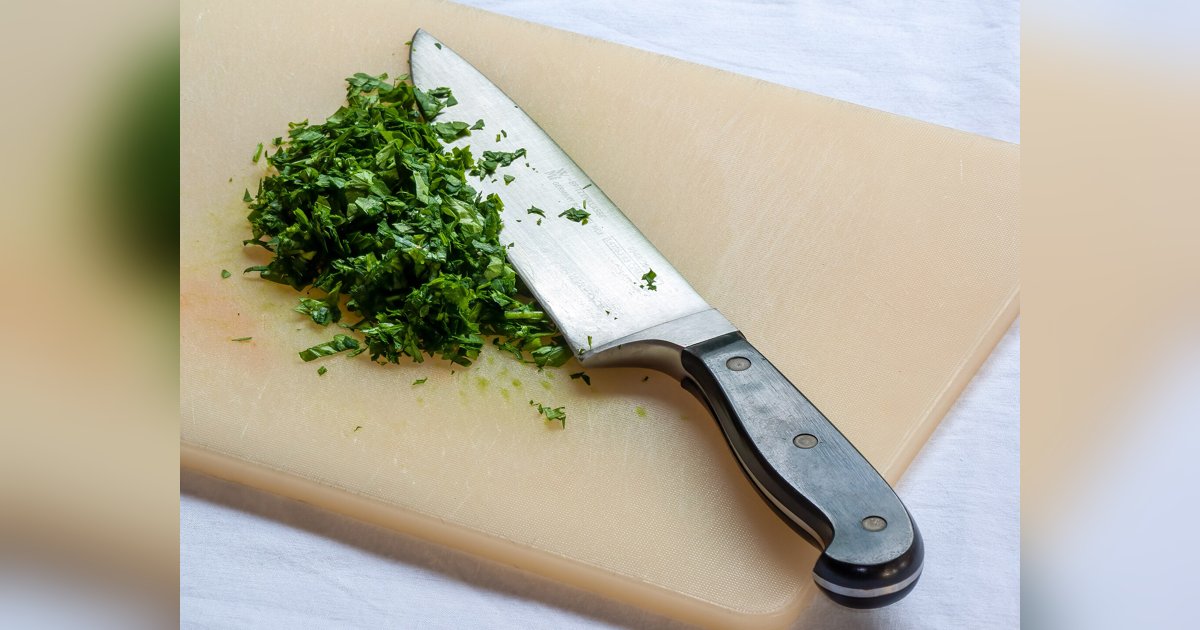
You do not need ten knives to cook well. You need one good one and the confidence to use it. Strong knife skills reduce prep time, make food cook evenly and, perhaps surprisingly, lower your chance of injury. A dull, wobbly technique is far more dangerous than a sharp, controlled one.
Pick the Right Tool
A chef’s knife with an eight-inch blade handles most jobs. A small paring knife and a serrated bread knife complete a practical trio. Choose a handle that fits your hand comfortably. Stamped or forged, Western or Japanese in style, the best knife is the one you feel secure holding. Go to a store and hold a few before buying.
Pair the knife with a stable cutting board. Wood or plastic are kind to blades, while glass and stone dull them quickly. Place a damp towel or a thin non-slip mat underneath so the board does not skid.
The Pinch Grip
Hold the knife by pinching the base of the blade between your thumb and the side of your bent index finger, just in front of the handle. The remaining fingers wrap around the handle. This grip gives you control over the tip and the angle, and it feels odd for the first few days. Resist the urge to hold the handle like a hammer with your finger pointing along the spine.
The Claw Hand
Your other hand holds the food, and it needs protection. Curl your fingertips inward like a claw, with your knuckles facing the blade. The flat of the knife can rest lightly against your knuckles as you cut, which guides each slice and keeps fingertips safely tucked. Move the claw backward in small steps as you slice.
Always create a flat surface on round foods before cutting. Slice a thin piece from an onion, potato or carrot and set that side down. A rolling vegetable is an accident waiting to happen.
Three Cuts to Practice
Start with the slice, then move to the dice and the mince. These cover most recipes.
- Slice: Use a smooth, forward and downward motion, letting the blade do the work rather than pressing hard.
- Dice: Cut the vegetable into planks, then into sticks, then into cubes. Aim for similar sizes so everything cooks at the same speed.
- Mince: Chop finely by rocking the blade over garlic or herbs, with the tip resting on the board and the handle rising and falling.
An onion is the best training vegetable. Halve it through the root, peel it, make horizontal cuts toward the root without cutting through, then vertical cuts, then slice across to produce a dice. Keep the root end attached to hold the layers together.
Speed Comes Last
Many beginners try to chop fast. Slow, even cuts build good habits and speed follows naturally. Practice on cheap vegetables like carrots, celery and onions for fifteen minutes a few times a week. Watch your hand position more than your knife. After a month, you will see a clear improvement in neatness and pace.
Keep It Sharp
A sharp knife cuts cleanly with little pressure, while a dull one slips off tomato skins and crushes herbs. A honing steel straightens the edge between sharpenings, and you can use it every few uses. A whetstone or a quality pull-through sharpener restores the edge a few times a year, depending on use.
Wash and dry the knife by hand right after use and store it in a block, on a magnetic strip or in a sheath. Never toss it loose into a drawer, and never leave it in a sink full of water where someone could reach in blindly.
Safe Habits for Building Knife Skills
Cut with your attention, not your phone. Do not try to catch a falling knife; step back and let it drop. If you want more confidence, an in-person class lasting an hour or two can correct habits quickly. Solid knife skills are among the best investments you can make in your kitchen, and they cost almost nothing.
Finally, remember that knife skills are mostly repetition. Cook with your knife often, even for small jobs like slicing a single clove of garlic. Choose recipes that require plenty of chopping, such as soups and stir-fries, and treat each one as practice. Within a few weeks, the grip and claw hand become automatic, and prep becomes the calm part of the meal instead of the stressful one.
For more background, see the Wikipedia article.